
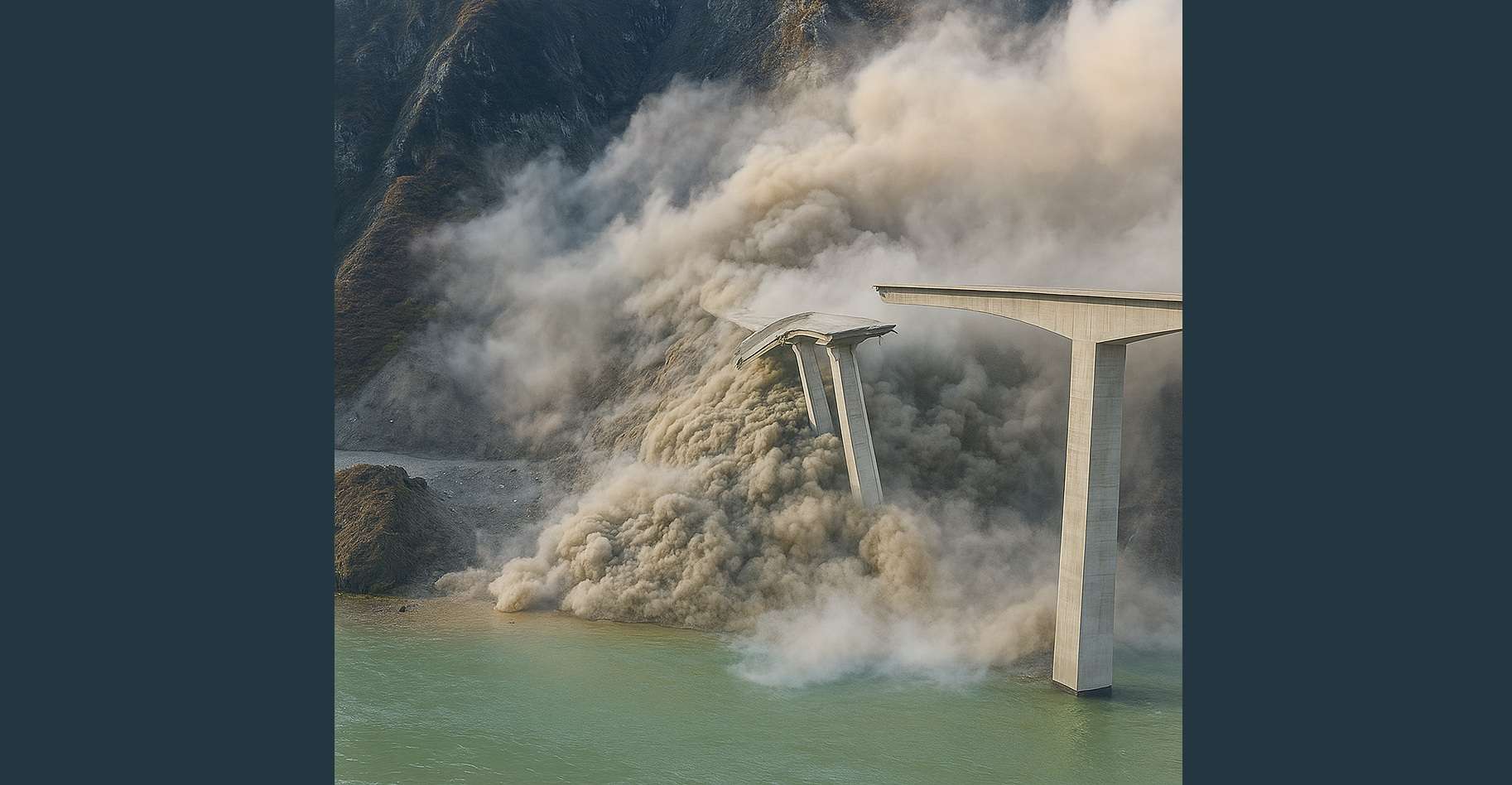
Hongqi Bridge collapse in Sichuan: Newly built 758‑meter span falls after landslide, no casualties reported
The newly built 758‑meter Hongqi Bridge in Sichuan collapsed into the river on Nov. 11, 2025, after a massive landslide. Authorities had closed the span a day earlier after cracks were found, and no casualties were reported.
Key takeaways
- Bridge failure: The 758‑meter Hongqi Bridge collapsed after a large landslide on Nov. 11, 2025.
- No casualties: Inspectors closed the bridge a day earlier after detecting cracks and ground movement, preventing injuries or deaths.
- Investigation ongoing: Officials are probing the landslide and whether engineering or construction faults contributed.
- Wider concern: The collapse raises questions about slope management and oversight on large projects in unstable terrain.
What happened
On Nov. 11, 2025, a massive landslide on the steep mountainside beside the Hongqi Bridge triggered a progressive failure: large sections of the deck broke and plunged into the river below, producing dust and debris clouds captured in video footage.
Video reports show the deck failing in stages as the adjacent hillside gave way.
See original reporting from Fox News and The Independent, and video footage of the collapse for the visual record.
What happened on Nov. 11
Circulating footage captures the moments large spans of the bridge plunged cleanly into the river, with the deck fracturing and sinking as the adjacent slope failed. Observers describe dramatic sections of the structure falling and raising large dust plumes.
Additional footage is available here: additional video.
Early warning signs and the decision to close
Inspectors detected visible cracks and abnormal ground movement the day before the collapse. Authorities quickly closed the bridge to traffic, an action credited with preventing what could have been a deadly outcome given how rapidly the collapse unfolded.
That preemptive closure highlights the value of active monitoring, routine inspection protocols, and rapid decision-making when signs of instability appear.
Background on the Hongqi Bridge and its role
The Hongqi Bridge was a major new highway span, roughly 758 meters long, built to strengthen links between central China and the Tibetan plateau as part of wider road‑network expansion across western mountainous provinces. It had opened to traffic only months earlier as part of regional development efforts.
Cause and engineering concerns
Local officials attribute the collapse to a large landslide on the adjacent mountainside that undermined the bridge supports. Investigators will examine whether geological surveys, foundation design, or construction quality adequately accounted for slope risk and local conditions.
Engineers emphasize that projects in geologically unstable terrain require conservative design margins, detailed subsurface investigation, slope stabilization measures, and continuous monitoring to detect ground movement early.
Why the collapse has raised alarm
The failure underscores vulnerabilities when large infrastructure is sited in unstable landscapes. Observers — both domestic and international — have pointed to the rarity of such a collapse so soon after opening and the need for rigorous oversight of geological assessment, construction supervision, and long‑term monitoring.
Questions likely to be central to the investigation include:
- Were geological surveys complete and accurate?
- Did design and foundation work allow for known slope hazards?
- Was construction quality and supervision sufficient?
- Were monitoring and early‑warning systems effective?
Public reaction and media coverage
Footage of the collapse circulated widely on social media and in international outlets, prompting analysis of visual evidence and debate about development speed versus safety. Domestically, the event revived concerns over rapid construction and whether corners were cut; internationally, commentators noted the narrow escape because the bridge was closed when it fell.
Official response and the investigation
Local authorities confirmed the collapse and said they are investigating the landslide and whether any engineering or construction issues contributed. Officials emphasized the absence of casualties and are prioritizing recovery, assessment of downstream impacts, and technical reporting on slope failure, foundation conditions, and structural response.
Implications for Los Angeles, California
The Hongqi Bridge collapse offers several lessons for jurisdictions like Los Angeles:
- Infrastructure safety awareness: Even new structures can fail in risky terrain — maintain rigorous inspections and monitoring.
- Landslide and slope management: Prioritize slope stabilization, drainage, and early‑warning systems where roads traverse unstable hillsides.
- Public confidence and communication: Quick closures and transparent communication can prevent casualties and preserve public trust.
- Engineering standards and oversight: Independent audits, strict enforcement of codes, and thorough geotechnical reviews are essential for major projects.
- Economic and emergency planning: Test redundancy in critical routes and update contingency plans to mitigate sudden transport losses.
Sources and further reading
Reporting and footage cited in this article:
- Fox News: “Major Chinese bridge collapses into river just months after opening to traffic”.
- The Independent: “China bridge collapse Hongqi Sichuan”.
- Video footage of the collapse (YouTube).
- Additional video footage (YouTube).
Investigations into the landslide and the bridge’s design and construction are ongoing, with officials promising detailed technical reports in the coming days and weeks.


