
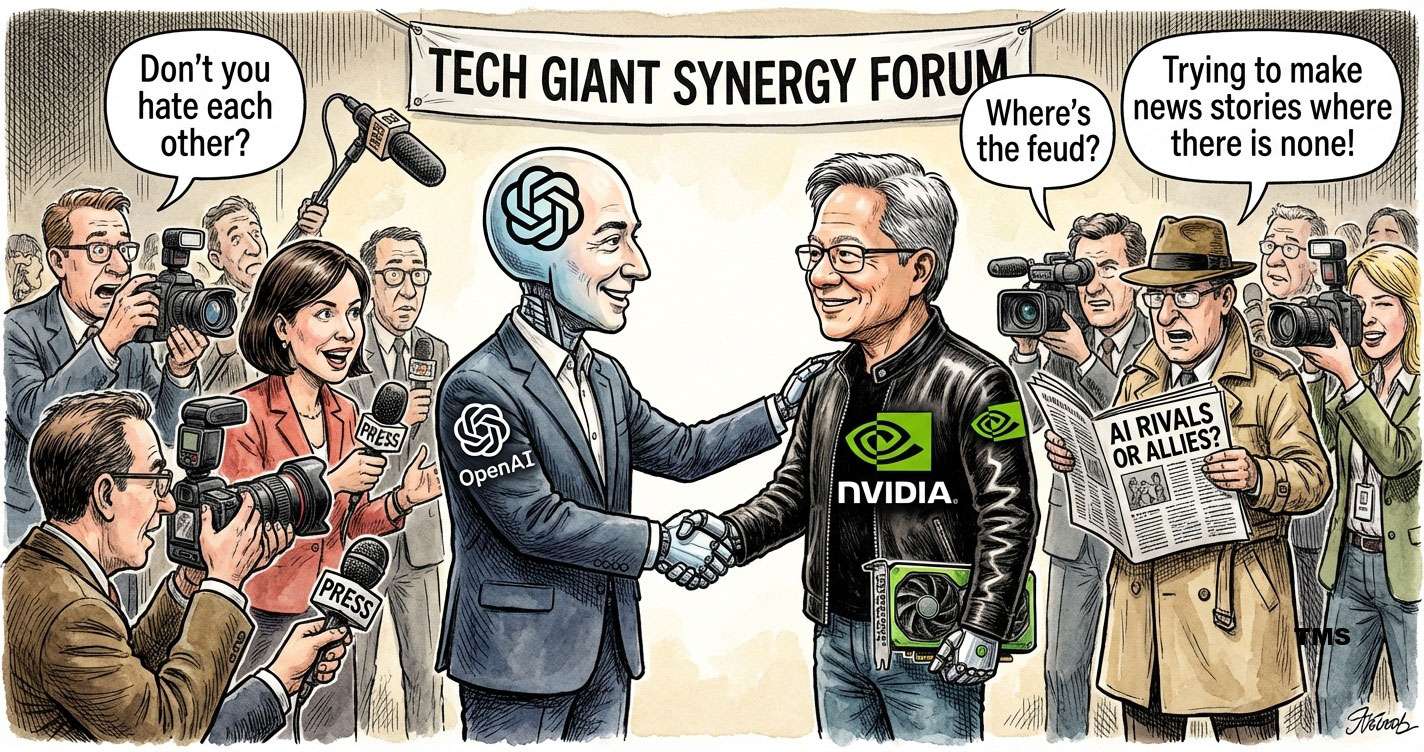
Nvidia CEO Jensen Huang says company will make a “huge” OpenAI investment, pushes back on reports it stalled
Nvidia CEO Jensen Huang confirmed in Taipei that the company will make a ‘huge’ investment in OpenAI, calling reports of a stalled $100 billion plan ‘nonsense’ and reaffirming Nvidia’s strategic partnership and ongoing infrastructure support.
Key takeaways
- Nvidia plans a very large investment in OpenAI that Huang described as “huge” and among Nvidia’s biggest commitments. Sources: TechCrunch, Bloomingbit.
- The original September 2025 plan envisioned up to $100 billion in staged investment and 10 gigawatts of Nvidia systems; the companies are now negotiating size and timing. See the Nvidia investor release.
- Reports of a stall reflected internal debate inside Nvidia and private remarks by Huang — which Nvidia publicly disputes — and media now describe likely equity investment in the tens of billions.
- Local impacts for regions like Los Angeles include demand for chips, hiring, research partnerships, and policy questions about power, zoning and workforce transition.
Main content
What Nvidia and OpenAI announced in 2025
In September 2025 the companies unveiled a broad strategic partnership that linked Nvidia’s AI infrastructure to OpenAI’s computing needs. The public framework described up to $100 billion of staged investment tied to deployed hardware and a plan to build 10 gigawatts of Nvidia systems, with the first phase expected online in the second half of 2026. That announcement positioned Nvidia as both a major investor and the hardware backbone for OpenAI’s growth. (See the Nvidia investor release (Sept. 2025).)
Why reports said the deal had stalled
This week The Wall Street Journal reported internal concerns at Nvidia about scope and terms, and subsequent summaries by media suggested the plan had hit hurdles. TechCrunch summarized coverage noting Huang had privately described the $100 billion figure as non-binding and criticized perceived lapses in business discipline at OpenAI. Those private comments, as reported, helped fuel stories that the partnership was under strain.
Huang’s response in Taipei
Speaking to reporters in Taipei, Huang rejected the idea that Nvidia was unhappy with OpenAI and called suggestions of friction “nonsense”. He said Nvidia would “definitely participate” in OpenAI’s latest funding round because “it’s such a good investment.” Huang declined to confirm a precise number and said OpenAI CEO Sam Altman should announce fundraising details; he said Nvidia would invest “a great deal of money” but avoided restating the $100 billion headline. Sources for Huang’s remarks include TechCrunch and Bloomingbit.
“It’s such a good investment,” Huang said, adding that Nvidia would “definitely participate” in the funding round.
OpenAI’s public position
An OpenAI spokesperson said the companies are “actively working through the details of our partnership” and emphasized that Nvidia “has underpinned our breakthroughs from the start, powers our systems today, and will remain central as we scale what comes next.” OpenAI has not announced firm fundraising totals; current reporting indicates discussions may focus on equity commitments in the tens of billions rather than the original $100 billion headline. (Statement cited in TechCrunch.)
What “tens of billions” means for AI infrastructure investment
Industry reporting suggests the earlier $100 billion figure was a staged, long-term signal for hardware build-out tied to deployed systems. Media coverage now describes a potential near-term equity stake and hardware commitments in the tens of billions — still a major infrastructure investment that would fund large-scale purchases of Nvidia chips and systems used to train and run advanced models. Analysts say a smaller near-term number could make the commitment easier to manage internally while preserving the supplier-customer relationship.
Why this matters: market power, competition and discipline
The reporting highlights three issues shaping the AI market:
- Market power: Large supplier investments can lock in demand and influence competitive dynamics because Nvidia chips are central to training top AI models.
- Internal discipline: Internal doubts at Nvidia illustrate the balance between bold strategic commitments and shareholder or operational caution.
- Product vs. commercial growth: Huang’s reported private criticism of OpenAI’s business discipline underscores a debate about pace of product development versus steady, revenue-driven growth.
Implications for Los Angeles, California
Economic impact
Los Angeles’ growing tech sector, AI startups and film/media companies could see increased demand for advanced chips and cloud GPU time. That can raise costs for local startups that rent compute but may also expand access to enterprise systems and partnerships, potentially driving hiring in AI engineering, data center operations and cloud services.
Academic and research ties
Major research institutions like UCLA and USC may gain opportunities for hardware access, joint research programs, and industry funding. A well-funded Nvidia‑OpenAI partnership could influence campus research priorities toward large-scale model work and infrastructure collaboration.
Film, media and entertainment effects
Hollywood studios and VFX houses using AI for production may benefit from faster tools and reduced costs, but must invest in new pipelines and retraining to leverage larger AI models and faster GPUs.
Workforce and jobs
Short-term demand for chips may favor larger companies with supply deals, tightening access for startups. Over time, broader investment can create roles across engineering, data center ops, sales and AI ethics, prompting a need for expanded workforce training programs.
Policy and civic concerns
City and county leaders will monitor effects on data privacy, job shifts, and infrastructure demands such as power and cooling. Large AI infrastructure projects can raise electricity needs and trigger zoning and permitting questions; local policymakers may also consider workforce protections and retraining support.
Practical effects for Angelenos
For residents, immediate effects are likely indirect: improved consumer AI products, faster media tools, and more local tech hiring. But increased data center demand and specialized labor needs may follow; civic groups may push for transparent planning around jobs, housing and public services.
Sources and verification
This article draws on Jensen Huang’s Taipei remarks and media reporting that summarized internal discussions and prior announcements. Key source material includes:
- TechCrunch
- Nvidia investor release (Sept. 2025)
- Report summarizing Huang’s Taipei remarks (Bloomingbit)
Reporting note: This story is based on Jensen Huang’s public remarks in Taipei and industry reporting. Company statements and media coverage indicate partnership details — including exact equity and infrastructure commitments — are still being negotiated. Sources: TechCrunch, Nvidia investor release, Bloomingbit.


