
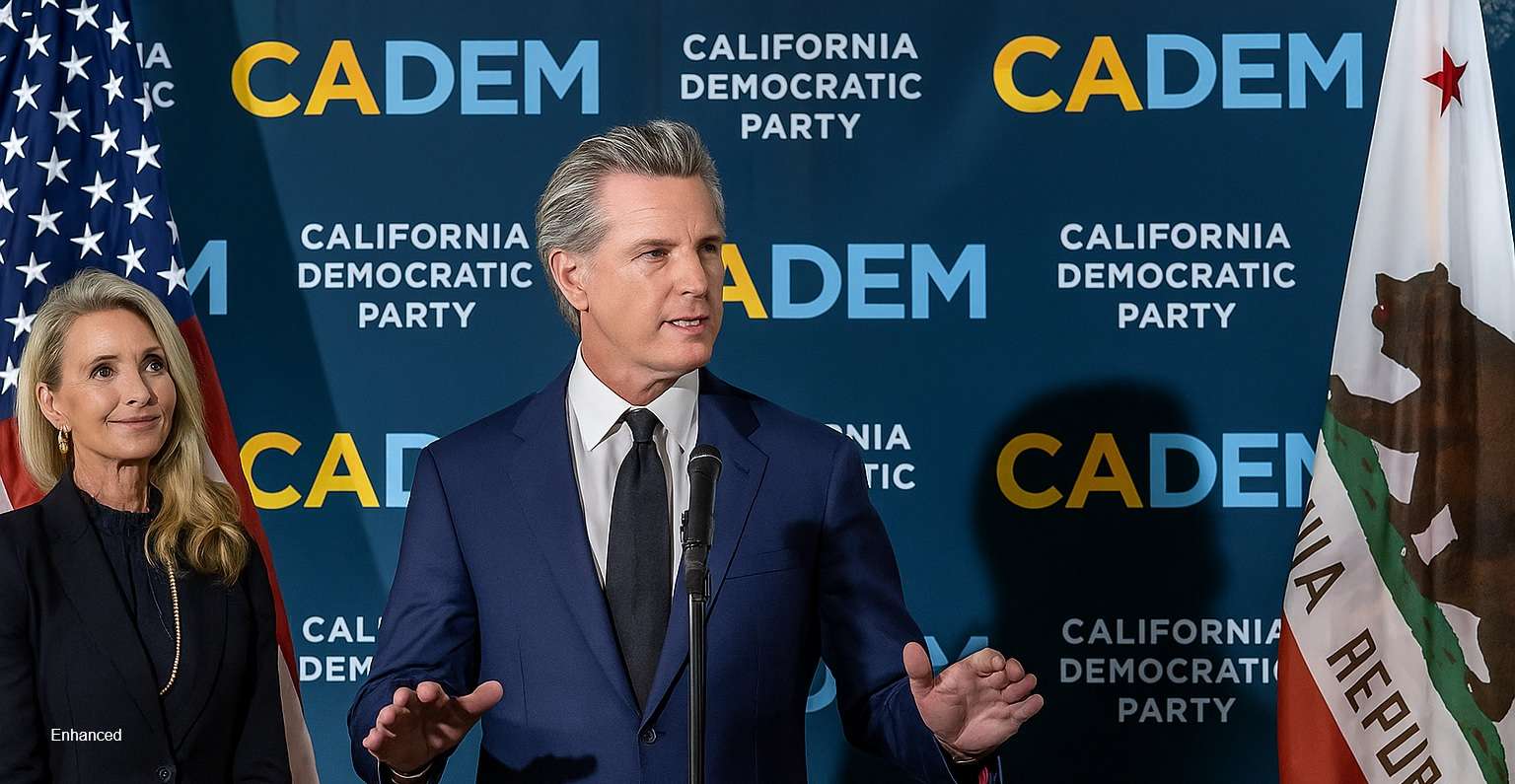
Newsom frames Proposition 50 win as “victory for democracy,” blasts Trump for voter intimidation as California prepares to redraw congressional maps
Sacramento, California (Times Media Service) — Governor Gavin Newsom hailed Proposition 50’s passage as a victory for democracy, criticized former President Trump for alleged voter intimidation, and urged other states to act while California prepares to redraw its congressional maps.
- Passage seen as a defense of democratic norms: Newsom called Proposition 50 “a victory for the United States of America” and framed the result as protecting democratic principles (Gov. Newsom remarks).
- Redistricting power shifts: The measure transfers congressional map authority to lawmakers and could yield up to five additional U.S. House seats for Democrats when maps are redrawn (California Secretary of State, Los Angeles Times, The New York Times).
- National call to action: Newsom urged states such as Virginia, Maryland, New York, Illinois and Colorado to “meet this moment head on” in defense of election integrity (AP, Los Angeles Times).
What Newsom said on election night
Gov. Newsom appeared at a live event after early returns showed Proposition 50 passing statewide. He opened by framing the result as a defense of the nation’s founding principles, saying it was “a victory for the United States of America, for the people of this country, and the principles that our founding fathers lived and died for.” For the full text of his remarks, see the governor’s office.
On President Trump: Newsom called him “an historic president” and said he had become “the most historically unpopular president in modern history,” accusing Trump and allies of conduct amounting to “vandalism to this republic and our democracy.” Those comments echoed post-election reporting and concerns documented by AP and the Los Angeles Times.
Rejecting authoritarianism
“In the U.S., there are no crowns, no thrones, no kings.”
Newsom used that line to stress that power rests with the people and the rule of law. He positioned Proposition 50 as a democratic tool to ensure citizens elect representatives who reflect communities — not to entrench a single leader or party.
National call to action
Beyond California, the governor urged lawmakers and voters to push back against tactics that undermine confidence in elections. He specifically named Virginia, Maryland, New York, Illinois and Colorado as states that should “meet this moment head on,” calling for collective defense of democratic norms and election integrity (AP, Los Angeles Times).
How Proposition 50 changes redistricting
Process change: Proposition 50 moves substantial control of congressional redistricting from the citizen-led independent commission to the state Legislature, meaning lawmakers — where Democrats hold a majority — will have the leading role in drawing California’s U.S. House maps.
Analysts note the shift could produce significant gains for Democrats. Some projections estimate up to five additional congressional seats by the 2026 midterms, depending on how lines are drawn and future voter behavior. See the official measure text and election results at the California Secretary of State and analysis from the New York Times and Los Angeles Times.
Reactions and perspectives
Supporters celebrated Proposition 50 as a way to make maps accountable and ensure fair representation; some voting-rights advocates argued elected officials can better respond to constituents. Opponents warned the measure hands too much power to partisan lawmakers and risks gerrymandering that protects incumbents.
On election night, Newsom thanked voters and organizers, and singled out people who said they felt “bullied and intimidated,” promising the state would stand up for those voters and for democratic norms.
Fact-checking key claims
- Redistricting authority: Accurate — Proposition 50 changes the process for congressional redistricting in California; see the California Secretary of State.
- Seat projections: Estimates that Democrats could gain up to five seats come from modeling by state and national analysts; these are projections dependent on map specifics and voter behavior (The New York Times, Los Angeles Times).
- Claims about intimidation: Newsom’s statements reflect his political view; reporting by national outlets documents concerns tied to post-election rhetoric and actions (AP, Los Angeles Times).
Implications for Los Angeles, California
Economic impact
Redistricting could indirectly affect federal funding flows to Los Angeles. New members of Congress can influence infrastructure, transportation and public safety grants; shifts in committee assignments and seniority may change project outcomes and priorities (New York Times).
Political consequences
If maps are redrawn by a Democratic-led Legislature, Los Angeles-based districts may be configured to bolster incumbents or create safer Democratic seats, affecting local party strategy, candidate recruitment and campaign focus ahead of future cycles (Los Angeles Times, California Secretary of State).
Social effects
Newsom’s promise to stand up for voters who felt “bullied and intimidated” resonates in immigrant and diverse communities across Los Angeles. Local civic groups and nonpartisan organizations are likely to increase voter-education and protection efforts ahead of future redistricting hearings.
Cultural relevance
Los Angeles’ civic and cultural institutions may host forums to discuss the map changes and encourage community engagement. Newsom’s line that “there are no crowns, no thrones, no kings” is likely to strike a chord in communities focused on democratic inclusion.
Practical applications for residents
- Stay informed: Watch for public hearings and opportunities to submit map recommendations at the California Secretary of State.
- Participate locally: Attend voter-education events hosted by community organizations to understand redistricting impacts.
- Monitor federal priorities: Local officials should brief any new or returning members of Congress on Los Angeles funding needs and project priorities.
- Protect voter access: Report intimidation and seek legal help through county election offices and state resources (California Secretary of State).
Reporting and follow-up
As the Legislature schedules hearings and begins the redistricting process, local newsrooms, civic groups and state officials will provide updates on proposed maps and timelines. Observers will watch how Proposition 50’s transfer of power alters representation and Los Angeles’ role in national politics. For ongoing updates, consult the California Secretary of State, the governor’s office, and coverage by the Los Angeles Times.
Sources
- Gov. Gavin Newsom — full remarks (governor’s office)
- California Secretary of State — election results and proposition text
- Associated Press — election night coverage and analysis
- Los Angeles Times — reporting on Proposition 50 and Newsom’s remarks
- The New York Times — redistricting analysis and national context
- CNN — coverage of national reaction to California results and redistricting implications


