
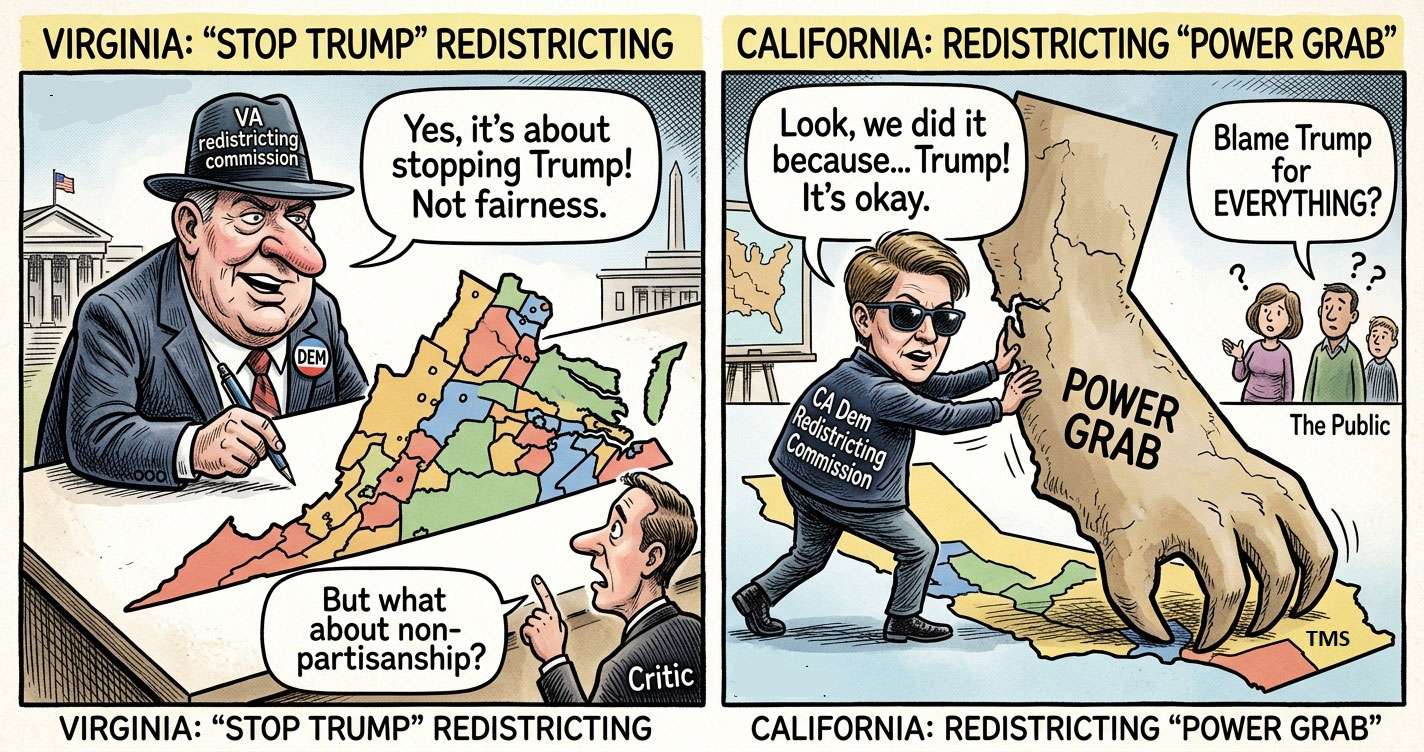
Virginia Democrats push referendum to redraw 2026 map; critics call it a partisan power grab
Virginia Democrats advanced a constitutional amendment to pause the bipartisan redistricting commission and let lawmakers redraw congressional districts before the 2026 midterms, a move critics call a partisan gerrymander that could produce a 10-1 Democratic-leaning map.
Key takeaways
- The amendment would let the General Assembly redraw congressional districts ahead of the 2026 elections and temporarily pause the bipartisan commission created in 2020. Video overview including comments and map releases and timeline and special session coverage.
- Supporters say it restores fairness after commission maps produced Republican gains; sponsors include House Speaker Don Scott and Senate Majority Leader Scott Surovell, with Gov. Abigail Spanberger publicly supporting a short-term fix. Supporters frame this as correcting a perceived imbalance.
- Critics call it a gerrymander designed to craft up to a 10-1 Democratic-leaning map, with legal challenges already filed by Republican groups including the RNC and NRCC. Legal challenge reporting.
- Public polling favors the independent commission: a February Roanoke College poll found 62% of Virginians favored the independent system, with 52% opposing the amendment and 44% supporting it. Polling and public reaction coverage.
What the referendum would change
The amendment asks voters whether the Constitution of Virginia should be amended to allow the General Assembly to adopt temporary congressional districts before the 2026 elections. Supporters argue the change would restore fair representation after the 2020 independent commission’s maps produced Republican gains.
Democrats negotiated a map during a special session in October 2025. Public reports indicate lawmakers settled on a 10-1 split for Democrats by February 6, 2026, after debating a 9-2 option. The released map reshapes several districts by drawing populations from dense, Democratic areas like Fairfax County into more rural Republican territory.
Critics have described many of the resulting district shapes as “spaghetti” or “scorpion” districts because they snake across large areas to connect Democratic voters, a design opponents say reveals the partisan aim behind the plan. Map analysis and district shapes, additional session and strategy reporting.
How the map could shift seats
Under current lines, Virginia’s congressional delegation is roughly split between Democrats and Republicans. The Democrats’ proposed 2026 map could flip up to four Republican-held seats by stretching Democratic population centers into districts that now favor GOP lawmakers. Many of the shifts draw heavily from Fairfax County and Northern Virginia suburbs. Supplemental map discussion.
Republican reaction and political rhetoric
Republican leaders have framed the amendment as a blatant partisan power grab. House Minority Leader Terry Kilgore, R‑Gate City, told Fox News Digital the plan was “manifestly unfair” and warned Democrats would be “silencing nearly half the Commonwealth’s voters.”
“Manifestly unfair… silencing nearly half the Commonwealth’s voters.” — House Minority Leader Terry Kilgore (R‑Gate City)
Senate Minority Leader Ryan McDougle called the broader Democratic agenda a “fake affordability agenda” and described the redistricting push as another “phony” plan to tilt power. Rep. Ben Cline (R‑Va.) said the effort is “about political power” and accused Democrats of trying “to rig the map.”
Legal fights
Republican groups, including the Republican National Committee and the National Republican Congressional Committee, have filed court challenges against the process and the map. State courts have already found procedural flaws in parts of the effort, and Democrats are appealing those rulings. These legal battles could delay or alter whether the map is used in 2026. Legal challenge reporting.
Public opinion and early voting context
Early voting for the April referendum began March 6, 2026. Observers noted turnout patterns that some said leaned toward Republican voters, raising concerns among Democrats who want passage. However, a February Roanoke College poll showed strong public preference for the independent redistricting system: 62% favored the commission, while 52% opposed the amendment and 44% supported it. Polling and public reaction coverage.
Democratic rationale and Rep. Beyer’s comments
Democrats argue the 2020 commission produced maps that handed ground to Republicans and that a temporary legislative fix is needed to “restore fairness” statewide. Rep. Donald Beyer, who represents Alexandria and parts of Fairfax County, told NBC News the redistricting effort is “not a done deal by any means” and argued Democrats must make the case that, despite appearing unfair in Virginia, the change could help Democrats “take back the House.” Opponents seized on those remarks as evidence the plan serves national party aims as well as local goals. Video overview including comments and map releases.
Requests for comment
Fox News Digital and other outlets reached out to Rep. Beyer and Gov. Abigail Spanberger for reaction after those comments. As of the reports reviewed, no additional public responses from Beyer or Spanberger were posted. Requests remain outstanding in public coverage. Video overview including comments and map releases.
Local examples and controversies
Opponents point to concrete harms for specific districts: Rep. Ben Cline’s Shenandoah Valley district is targeted to be split and connected to Fairfax County under the new map. House Minority Leader Kilgore’s southwest district would become the lone Republican-favored district under the plan. A Page County Democratic billboard urging a “yes” vote tied to opposing Donald Trump drew attention and deepened the perception that the referendum ties state lines to national politics. Video overview including comments and map releases.
Where to see the sources
- Video overview including comments and map releases
- Timeline and special session coverage
- Polling and public reaction coverage
- Legal challenge reporting
- Map analysis and district shapes
- Additional session and strategy reporting
- Supplemental map discussion
Implications for Los Angeles, California
Economic impact
If Virginia’s congressional delegation shifts and contributes to a change in House control, federal funding priorities and committee assignments could shift nationwide. For Los Angeles, that could affect grant competition and federal programs for transit, housing, and climate initiatives already planned in Southern California.
Political consequences
A national change in House control — to which Virginia’s map could contribute — would alter the balance in Congress, affecting immigration policy, climate legislation, and infrastructure bills important to Los Angeles. Local leaders monitor Virginia because committee chairs influence federal support for city priorities.
Social effects
The Virginia debate feeds national conversations about voter representation, trust in elections, and civic engagement. If the referendum passes amid claims of partisan mapping, it could energize Los Angeles advocacy for independent commissions and voting reforms.
Cultural relevance
Los Angeles’ diverse electorate values fair representation; the fairness-versus-partisan-advantage framing in Virginia may shape local media and civic group narratives about map drawing and democratic legitimacy.
Practical applications
Civic groups and newsrooms in Los Angeles should watch Virginia’s legal appeals for precedents on mid‑decade redistricting and may use the case in voter education campaigns. Court rulings on whether a legislature can resume mapmaking mid‑decade could influence strategies elsewhere.


