
Iran Internet Shutdown 2026: Rights Groups Say Regime Cut Web to Hide Killings as Anti‑Government Protests Sweep Country
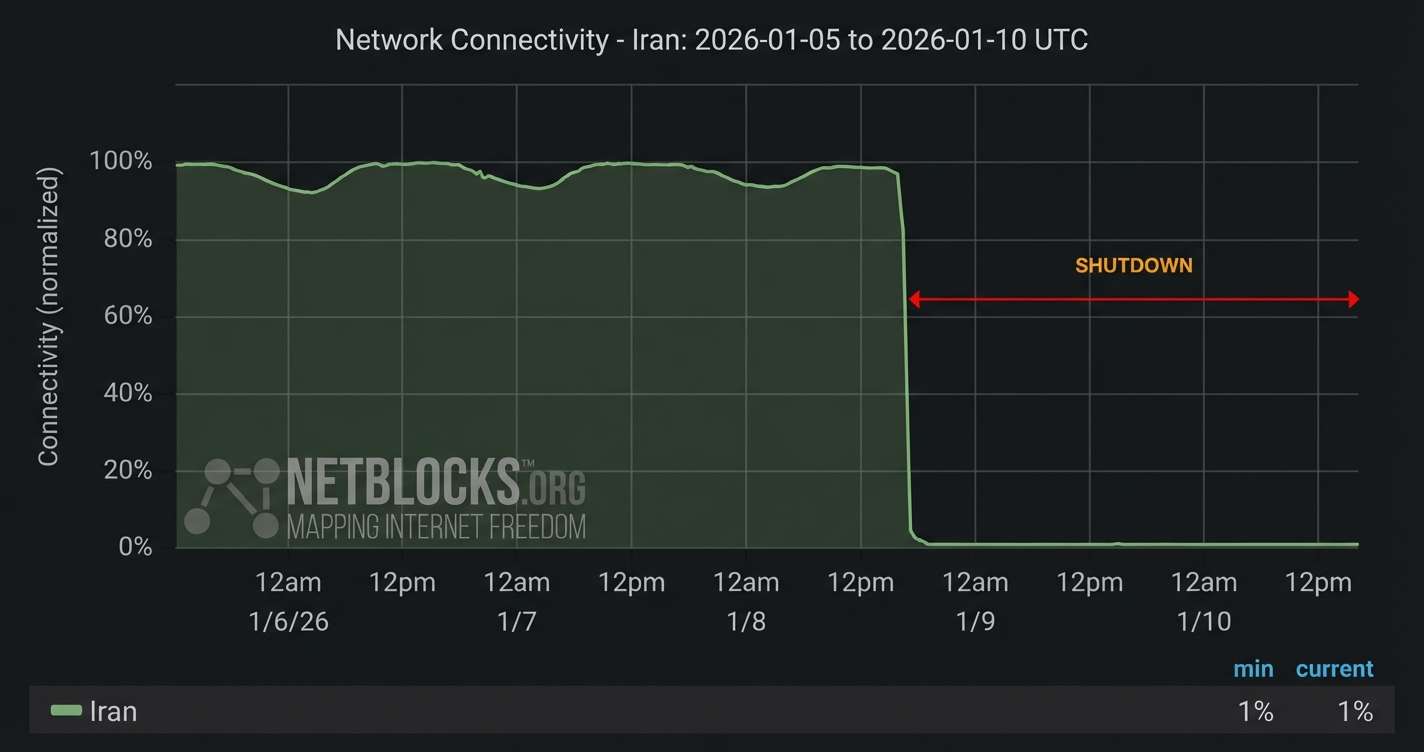
Iranian authorities initiated a nationwide internet and telecommunications shutdown on January 8, 2026, amid widespread anti‑government protests, a blackout rights groups say was used to conceal lethal force, mass arrests and other grave human rights violations.
- A near‑total “kill‑switch” cut mobile data, fixed lines and international traffic on January 8, 2026 — documented by Amnesty International and the Institute for the Study of War.
- Rights groups say the blackout helped conceal alleged shootings, beatings and mass arbitrary arrests, creating obstacles for independent documentation and accountability.
- Verified counts remain incomplete: Amnesty confirmed at least 28 deaths in early January; other sources cite higher figures and thousands detained.
- Protests began on December 28, 2025, after a sharp currency collapse and soaring inflation, spreading rapidly across scores of cities and provinces.
What happened — the internet “kill‑switch”
The shutdown: Iran’s state authorities appear to have flipped a near‑total “kill‑switch” on national communications on January 8, 2026. The measure severely limited mobile data, domestic fixed lines and outbound traffic to the global internet.
Analysis and reporting describe the cut as nationwide and prolonged, similar to earlier shutdowns in 2019 and 2022. Technical and human rights experts point to centralized control over Iran’s internet backbone and major providers, which allows authorities to throttle or stop traffic across the country. See reporting by Amnesty International and the Institute for the Study of War (ISW).
Footage and coverage, including a CNN‑News18 segment, described a “near‑total internet blackout” that lasted more than 36 hours while demonstrations were active in over 100 cities.
Why rights groups say the regime cut access
Amnesty’s Security Lab researcher Rebecca White said the blackout “deliberately blocked internet access inside Iran to hide the true extent of the grave human rights violations and crimes under international law” being carried out to crush the protests.
“Shutting down connectivity prevents documentation of abuses and helps create impunity for security forces,” Amnesty argued.
International human rights law treats blanket internet shutdowns as inherently disproportionate except under the narrowest and strictly necessary circumstances. Amnesty and other advocates argue the cutoff violates rights to freedom of expression, access to information and peaceful assembly — see Amnesty International.
Scale and spread of the protests
The unrest began on December 28, 2025, after a dramatic fall in the value of Iran’s currency and rapid inflation pushed many people into hardship. Demonstrations quickly spread from Tehran to cities and towns across every province, with demonstrators calling for political and economic changes.
Amnesty called this wave the largest nationwide protests since the 2022 “Woman, Life, Freedom” uprising. Open reporting confirms demonstrations in more than 100 cities, while some opposition sources claim activity in up to 180 cities; those higher figures have not been fully corroborated by the rights groups cited here. See the ISW update and related coverage.
Deaths, arrests and uncertainty over totals
Verified tolls: Amnesty has verified at least 28 deaths between December 31, 2025, and January 3, 2026, across 13 cities in eight provinces; verified victims include children. The group warned the true toll is likely higher and that further verification will take time due to restricted access and the communications blackout — Amnesty International.
Other reports from activists and some media outlets cite higher figures: televised reporting referenced at least 45 killed and suggested upwards of 2,000 arrests, while activist tallies circulated of 65‑plus killed and more than 2,300 detained. Those higher numbers are possible but not consolidated in a single, fully verified rights‑group report.
Nature of the security response
Amnesty and analysts report a pattern of violent repression: security forces allegedly used firearms and other lethal means against crowds, carried out mass arbitrary arrests, and deployed measures that mirror the 2019 and 2022 crackdowns when internet cuts accompanied heavy force.
Amnesty says this pattern suggests the shutdown enabled escalation with less oversight. The ISW tracked continued protest activity during the outage and noted the shutdown’s role in limiting outside monitoring.
International reaction and legal framing
Amnesty publicly condemned the crackdown and urged foreign governments and international bodies to press Iran to end unlawful force, release detainees and restore full internet access. Media coverage also noted strong rhetoric from U.S. officials about accountability, though immediate new policy actions were not detailed in available reporting — see Amnesty International and associated media segments.
How this fits Iran’s recent pattern
Analysts say the 2025–26 protests follow a familiar template: rapid mobilization; lethal force and mass arrests; and a national internet blackout once protests reach a critical scale. Similar tactics were used in the 2019 fuel‑price protests and the 2022 “Woman, Life, Freedom” uprising, which left hundreds dead and thousands detained while seeing near‑total or rolling internet disruptions.
Sources and verification limits
The details above come mainly from Amnesty International, the Institute for the Study of War, and media coverage including a CNN‑News18 segment. Human rights organizations typically publish conservative, verified baseline figures at first and update totals as evidence is gathered.
Key caveat: Given Iran’s tight control of information and history of shutdowns, researchers warn that confirmed numbers will likely rise as investigators gain access to more data.
Implications for Los Angeles
Economic impact: Los Angeles has a large Iranian‑American business and cultural community with ties to family, remittances and trade links. Prolonged instability and communications blackouts can disrupt money transfers, hinder small businesses that rely on contact with relatives or partners in Iran, and create supply‑chain uncertainty.
Political consequences: LA’s Iranian diaspora may press elected officials to call for stronger U.S. diplomatic action, expanded asylum support and local resolutions condemning human rights abuses. City Hall and regional representatives with large Iranian‑American constituencies will likely face constituent demands for statements and concrete measures.
Social effects: Many Angelenos have family in Iran. The blackout increases anxiety and uncertainty in neighborhoods; community groups and faith centers may organize vigils, rallies and information drives. Universities with Iranian students may receive requests for protective measures and flexible policies.
Cultural relevance: Iranian arts and culture are visible in Los Angeles life. The diaspora may use films, public forums and cultural events to draw attention to human rights concerns and maintain community solidarity.
Practical steps for residents:
- Support verified human rights organizations and reputable relief funds.
- Attend community briefings and trust organizations that vet information.
- Donate to established relief funds and contact local nonprofits coordinating legal aid for families.
- Tech caution: volunteers can share guidance on safe communications tools, but bypass tools carry risks for people inside Iran.
Media and civic response: Los Angeles newsrooms and Persian‑language broadcasters will likely increase coverage; local human rights groups and legal clinics can prepare to assist asylum seekers and those seeking protection. City emergency services and consular assistance offices should coordinate messaging for residents with family in Iran.


