
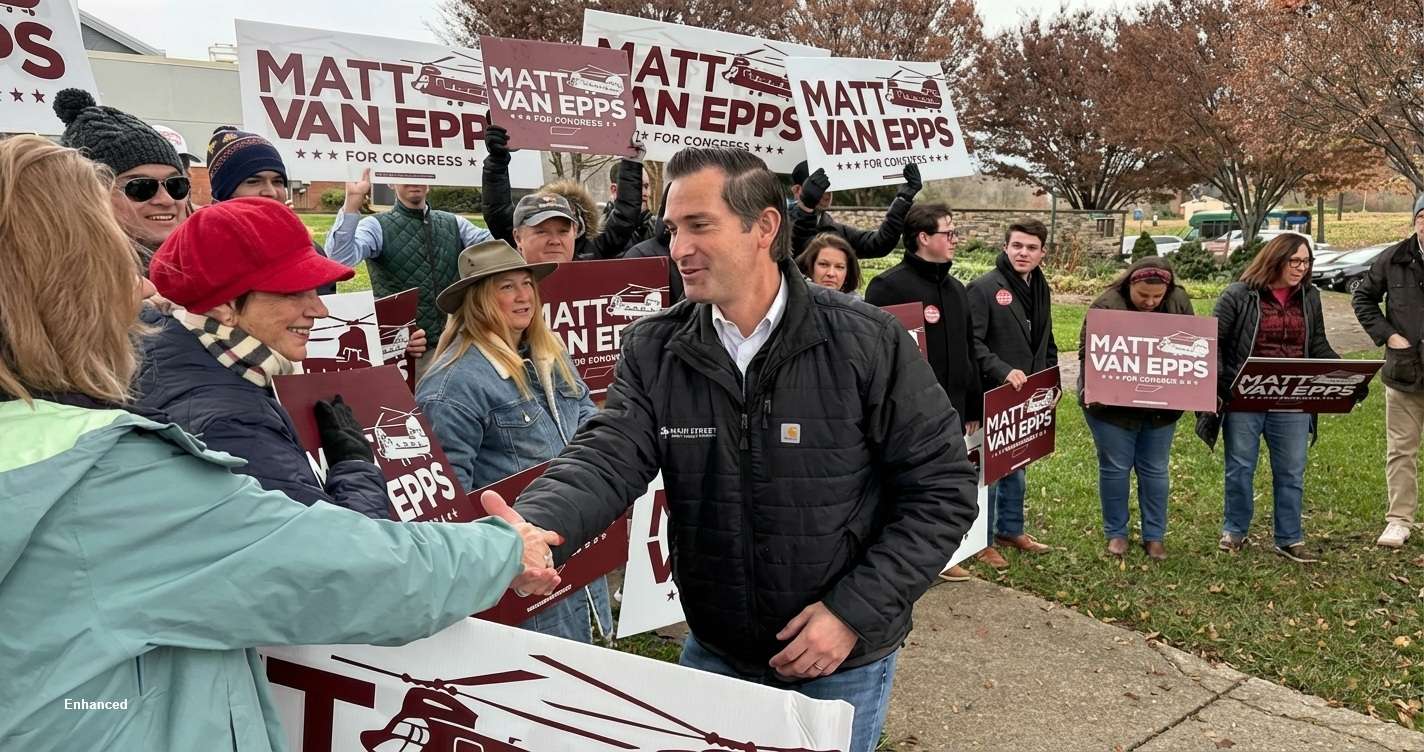
Trump-backed Republican Matt Van Epps wins TN-7 special election, keeping Tennessee seat in GOP hands
Republican Matt Van Epps defeated Democrat Aftyn Behn in the Dec. 2, 2025, special election for Tennessee’s 7th District, keeping the seat in GOP hands after Mark Green’s July resignation; Van Epps won with 53.9% of the vote.
Key takeaways
- Winner: Matt Van Epps (Republican) — 53.9% (Wikipedia: 2025 Tennessee’s 7th congressional district special election).
- Runner-up: Aftyn Behn (Democrat) — 45.0% (Wikipedia: 2025 Tennessee’s 7th congressional district special election).
- Vacancy: Seat opened after Rep. Mark Green resigned July 20, 2025 (Wikipedia: 2025 Tennessee’s 7th congressional district special election).
Main story
Background and why the seat opened
The vacancy: The TN-7 seat became vacant when Rep. Mark Green resigned on July 20, 2025, leaving Congress for a private-sector opportunity and prompting state officials to schedule a special election to fill the remainder of the 119th Congress term (ending Jan. 3, 2027).
State election officials set expedited filing deadlines and fast primary/general election dates. The contest drew national attention because the district — historically reliably Republican — showed signs of tightening after 2024 and in early 2025 contests. Analysts treated the TN-7 special election as a barometer for party strength ahead of 2026.
Source: Wikipedia: 2025 Tennessee’s 7th congressional district special election.
How the primaries shaped the general election
Republican primary: Matt Van Epps emerged with a clear plurality. A former commissioner of the Tennessee Department of General Services (2024–2025), he won the GOP nomination with 51.56%, carrying 12 of the district’s 14 counties. His closest rival, Jody Barrett, earned 25.33% and took only Dickson and Hickman counties.
Democratic primary: Aftyn Behn prevailed in a tight four-way race, winning with 27.89% and edging Darden Copeland, Bo Mitchell and Vincent Dixie. Behn’s margins came from strong showings in more populous Montgomery and Davidson counties and a narrow win in Williamson County.
Details: Wikipedia: 2025 Tennessee’s 7th congressional district special election.
Campaign themes, polling and turnout
The general election centered on a mix of local issues and national themes. Pre-election polling showed a close contest: an Emerson College poll conducted Nov. 22–24, 2025, had Van Epps ahead 48% to 46%, with small shares for third-party options and undecided voters.
Early voting ran Nov. 12–26, 2025, extending access ahead of the Dec. 2 election and shaping turnout patterns in suburban and urban pockets of the district.
Poll source: Wikipedia: 2025 Tennessee’s 7th congressional district special election.
Electoral results and what the numbers show
Final result: Matt Van Epps won the special election with 53.9% to Aftyn Behn’s 45.0%, an 8.9-point margin. While Republicans held the seat, Democrats narrowed the gap compared with 2024 results, signaling modest shifts in parts of the district that parties will study heading into 2026.
“Improved Democratic margins did not translate into a win, but they suggest changing dynamics that both parties will watch closely.”
Vote summary: Wikipedia: 2025 Tennessee’s 7th congressional district special election. The Associated Press called the race for Van Epps.
Fundraising and campaign spending
Fundraising totals:
- Matt Van Epps: about $992,716 raised, including roughly $761,549 in self-funding.
- Aftyn Behn: about $1,230,629 raised, including $708,892 in self-funding and $521,737 from other sources.
Campaign cash funded advertising, field operations and get-out-the-vote efforts. Van Epps’ county-level strength and primary consolidation helped mobilize conservative voters; Behn’s narrower primary win and broader urban/suburban appeals showed Democratic organizing capacity.
Source: Wikipedia: 2025 Tennessee’s 7th congressional district special election.
What this means for national politics and the 2026 norm test
Immediate effect: The result preserves Republican control of TN-7 for the remainder of the current Congress (term through Jan. 3, 2027).
Longer view: Democrats’ improved vote share — despite not flipping the seat — may encourage national strategists to target similar suburban/exurban districts in 2026. Republicans will point to durable support outside major urban markets.
Analysts will use the Van Epps–Behn contest as a case study in targeted messaging, turnout operations and the value of early voting periods ahead of the 2026 cycle.
Reference: Wikipedia: 2025 Tennessee’s 7th congressional district special election.
Implications for Los Angeles, California
Economic impact: Direct economic effects in Los Angeles are limited, but national donors and PACs based in Los Angeles or California may adjust 2026 allocations based on lessons from TN-7. Local fundraising groups could redirect resources to perceived competitive districts.
Political consequences: For Los Angeles leaders, the result underscores the importance of suburban and exurban outreach. Democrats may double down on suburban strategies; Republicans may highlight evidence that conservative messaging can hold in right-leaning districts.
Social and cultural relevance: Civic groups in Los Angeles can study the race to refine early voting drives and targeted outreach to underrepresented communities. Local media and civic leaders may debate how national themes translated to a Tennessee electorate.
Practical takeaway: Fundraisers and consultants in Los Angeles can apply TN-7 lessons — invest in early voting, tailor messages by county/neighborhood, and scale rapid field operations.
Sources and further reading
Full results and background: Wikipedia: 2025 Tennessee’s 7th congressional district special election.
Reporting note: The Associated Press called the race for Van Epps; vote totals summarized by election reporting show Van Epps at 53.9% to Behn’s 45.0% (Wikipedia: 2025 Tennessee’s 7th congressional district special election).
Reporting will continue as parties and analysts digest county-level returns, fundraising reports and the implications for the 2026 campaign calendar.


